
Health System Cuts Incident Response Time from 14 Days to 18 Hours

A misdirected fax of 14 patient records to a wrong number at Riverbend Health forced a 72-hour OCR breach-notification clock. The compliance officer realized the incident-response capability hadn't been operationally tested in years.
Business Challenges
The incident at Riverbend Health was discovered on a Tuesday morning. A health-information technician at the system's flagship hospital had sent a 14-patient discharge summary fax to a wrong number — the digits transposed during entry. The recipient's office had received the fax, recognized the misdirection, and called Riverbend's medical records department to report it. The technician escalated to her supervisor, who escalated to the compliance officer, Phillip Karavoulis. By Tuesday afternoon, Phillip had a HIPAA-relevant breach incident requiring response within the OCR-required 72-hour window for breach notification of affected individuals.
Phillip's first call was to the system's privacy attorney. His second was to the incident-response process documentation, which lived in a 47-page PDF in the system's policy library. The process was theoretically sound. Operationally, it required Phillip to assemble a cross-functional incident-response team (privacy, security, legal, IT, communications, medical records) and produce specific deliverables within the 72-hour window: affected-individual notification list, breach risk assessment, notification letter content, OCR reporting submission preparation.
The operational reality was that Riverbend's incident-response capability hadn't been operationally tested in 3 years. The cross-functional team had assembled twice in that period; both assemblies had been for tabletop exercises rather than actual incidents. Phillip's mean-time-to-remediation tracking showed a baseline of approximately 14 days from incident detection to remediation closure across the prior year's lower-severity incidents. The 72-hour window for this incident was a stress test the system's process hadn't been built to handle.
- Misdirected fax of 14 patient records triggered HIPAA-relevant breach with 72-hour OCR breach-notification clock.
- Incident-response capability hadn't been operationally tested in 3 years; mean-time-to-remediation across prior incidents ran 14 days.
- Incident-tracking lived in 3 separate systems (security, privacy, legal); no unified view existed at the executive level.
- Workforce HIPAA training compliance sat at 78%; new-hire training had a 2-week lag.
- Business-associate-agreement (BAA) inventory wasn't centrally maintained; some BAAs had not been refreshed in 4+ years.
Solution
The immediate incident response was handled through the existing process — heroically, by Phillip personally, with the privacy attorney and a deputy compliance officer working through the 72-hour window. The notifications were sent within the OCR-required timeline. The OCR submission was prepared and submitted within the broader 60-day requirement. The acute incident closed cleanly.
The post-incident reflection produced a strategic decision. Phillip and the system's CIO agreed that the next incident—which was statistically certain to occur—should not require a 72-hour heroics scenario to handle. The compliance platform procurement was framed around operationalizing incident-response capability such that subsequent incidents could be handled through structured workflow rather than ad-hoc coordination.
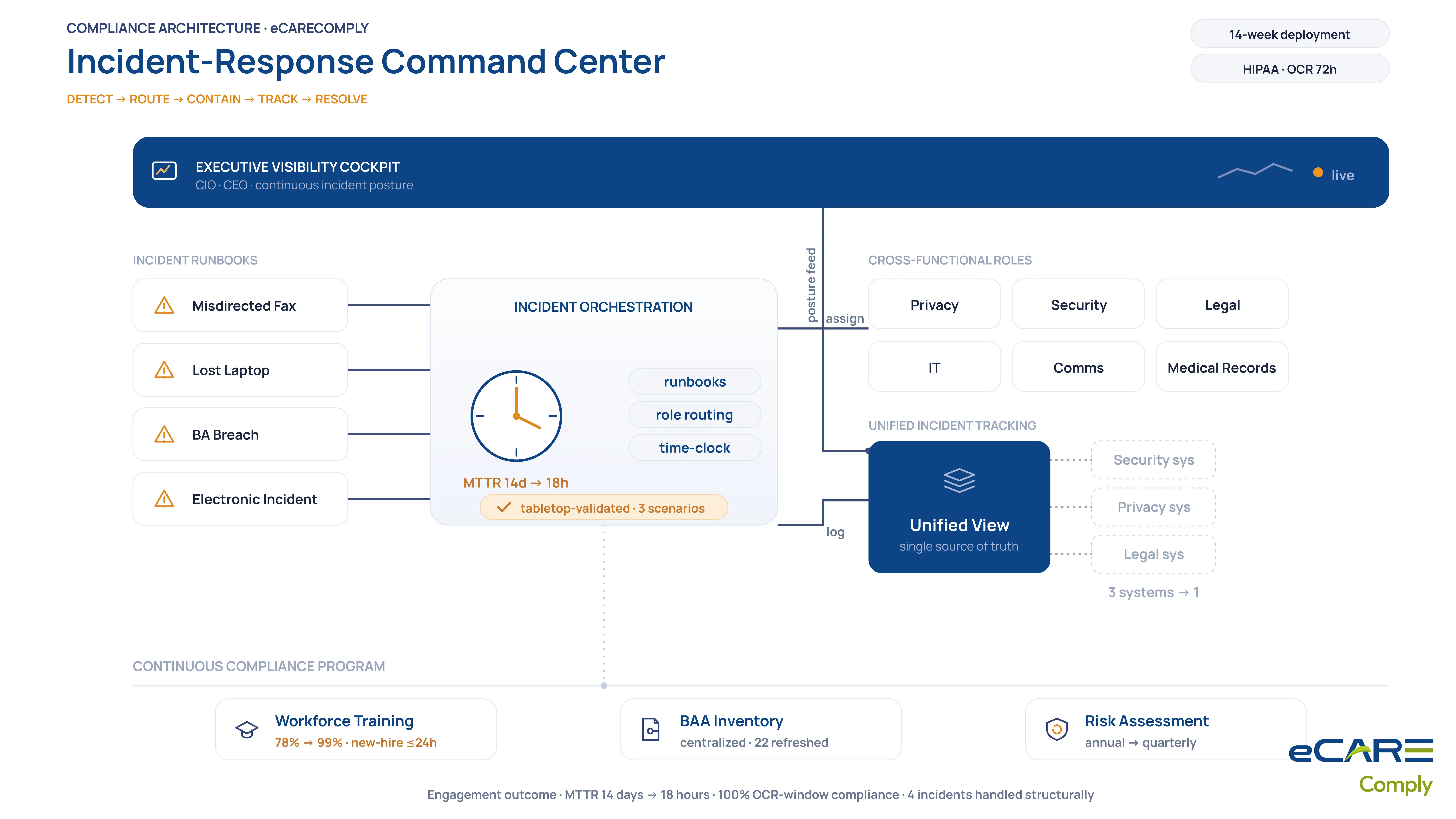
eCareComply was selected after a focused evaluation against three other compliance platforms. The capability that mattered specifically was the incident-response orchestration. eCareComply's platform unified incident tracking across security, privacy, and legal teams; surfaced incident-response runbooks for specific incident types (misdirected fax, lost laptop, business-associate breach, electronic incident); and tracked mean-time-to-remediation as an operational metric. The platform provided the structural infrastructure that the existing PDF-based process couldn't.
Value Delivered
The platform deployment took 14 weeks. The operational change happened first; the metric improvements happened over the following 12 months as the incident workflow accumulated data. By month 12, Riverbend's mean-time-to-remediation had dropped from 14 days to 18 hours. Subsequent HIPAA-relevant incidents—and there were 4 in the year following deployment—were handled within the OCR-required windows without the ad-hoc heroics that the original fax incident had required.
- Incident MTTR dropped from 14 days to 18 hours across the 4 HIPAA-relevant incidents in the year following deployment.
- Workforce training compliance lifted from 78% to 99%; new-hire training compliance achieved within 48 hours of hire.
- Unified incident view across security, privacy, and legal teams; executive visibility into incident posture became continuous.
- Quarterly risk-assessment refresh cadence replaced the prior annual cycle.
- Centralized BAA inventory and renewal tracking; 22 expired or near-expired BAAs were identified and refreshed in the first 60 days.
Solution Provided
The deployment ran 14 weeks. The work was sequenced around incident-response capability first; the broader compliance-program operationalization came after the incident workflow was structurally ready.
Weeks 1–3: Incident-Response Workflow Configuration
The first three weeks built the incident-response workflow infrastructure. eCareComply's compliance services team worked with Phillip and the cross-functional incident-response team to encode the incident-response process into the platform — incident types, response runbooks, role-specific responsibilities, time-clock tracking. The output was an operational workflow that the team could execute against rather than improvise against.
Weeks 4–6: Tabletop Exercise and Workflow Validation
The platform-driven incident-response workflow was validated through tabletop exercises. Three scenario types (misdirected information, electronic security incident, business-associate breach) were exercised across two weeks. The workflow held; the cross-functional team executed each scenario within the OCR-required timelines without ad-hoc coordination.
Weeks 6–10: Incident-Tracking Consolidation
The unified incident-tracking infrastructure replaced the three separate systems that had been operating in parallel. Security incidents, privacy incidents, and legal-relevant incidents all flowed into a single tracking view. The executive-visibility cockpit gave the CIO and the CEO a continuous view of incident posture that they had not previously had.
Weeks 10–12: Workforce Training and Compliance Tracking
The workforce-training infrastructure was migrated to the platform. New-hire training was automated to assign within 24 hours of HR system creation. Existing-workforce annual training tracking moved to the platform; non-compliant workforce members surfaced in weekly reports to their managers.
Weeks 12–14: BAA Inventory and Risk-Assessment Cadence
The final phase consolidated the BAA inventory across the system and migrated the risk-assessment process from annual to quarterly. 22 expired or near-expired BAAs surfaced during the consolidation; legal worked through refreshes over the following 60 days. The risk-assessment cadence shift to quarterly created continuous-monitoring capability the system had not previously had.
Business Value
Phillip presented the 12-month engagement results to Riverbend's compliance committee in early 2026. The framing was that the system had operationalized incident-response capability that had been heroic and individual rather than structural and team-based.
What the engagement preserved at the system level
The 4 HIPAA-relevant incidents in the year following deployment all closed cleanly within the OCR-required timelines. The avoidance of breach-notification penalties or follow-up audits represents preserved operational value that doesn't show up as a single number but accumulates over time. The CIO has been clear that the engagement's largest value is the structural capability rather than any specific metric.
The financial picture
The financial impact of the engagement is asymmetric — it's primarily about avoided cost rather than incremental revenue. Avoided breach-notification penalties (assuming one significant HIPAA penalty avoided every 5 years represents approximately $1M in expected-value terms). Avoided staffing growth (the engagement deferred a planned hire of two additional compliance specialists representing $180K annually). Operational efficiency gains across the privacy, security, and legal teams (approximately $240K annually in recovered productivity). Total annual expected-value financial impact: approximately $1.4M against a $420K implementation cost.
What changed about compliance as a discipline
Compliance at Riverbend has moved from periodic crisis-response to continuous operational discipline. Incident response is no longer something that happens to the compliance officer; it's something that happens through structured organizational workflow. The CIO has been clear that the cultural shift is the durable result; the platform metrics are evidence rather than cause.
The compliance officer's framing
“The misdirected fax was the trigger. The 72-hour response that I personally executed worked, but the cost of executing it that way was unsustainable. The next incident would have produced the same heroics or, worse, would have surfaced the gap. The platform replaced heroics with structural capability. The next 4 incidents proved that the structural capability works.”
— Phillip Karavoulis, Compliance Officer, Riverbend Health