Payvider Passes Surprise OCR Audit with Zero Findings

OCR audit notification arrived at Wellbridge Health Plan from a non-targeted random sweep. The 30-day evidence-production window started immediately. The compliance team's existing approach would have consumed every analyst for the duration.
Business Challenges
The OCR audit letter arrived at Wellbridge Health Plan on a Friday in April 2025. The notification was a random-sweep audit, not a complaint-triggered investigation. The audit scope covered HIPAA Privacy, Security, and Breach Notification Rule compliance across the payvider's 540,000-life membership. The evidence-production window was 30 days from notification receipt. The compliance officer, Renée Tucker, told her team in the all-hands Monday morning: “We will produce everything they ask for in the time they ask for it. We will not negotiate the window.”
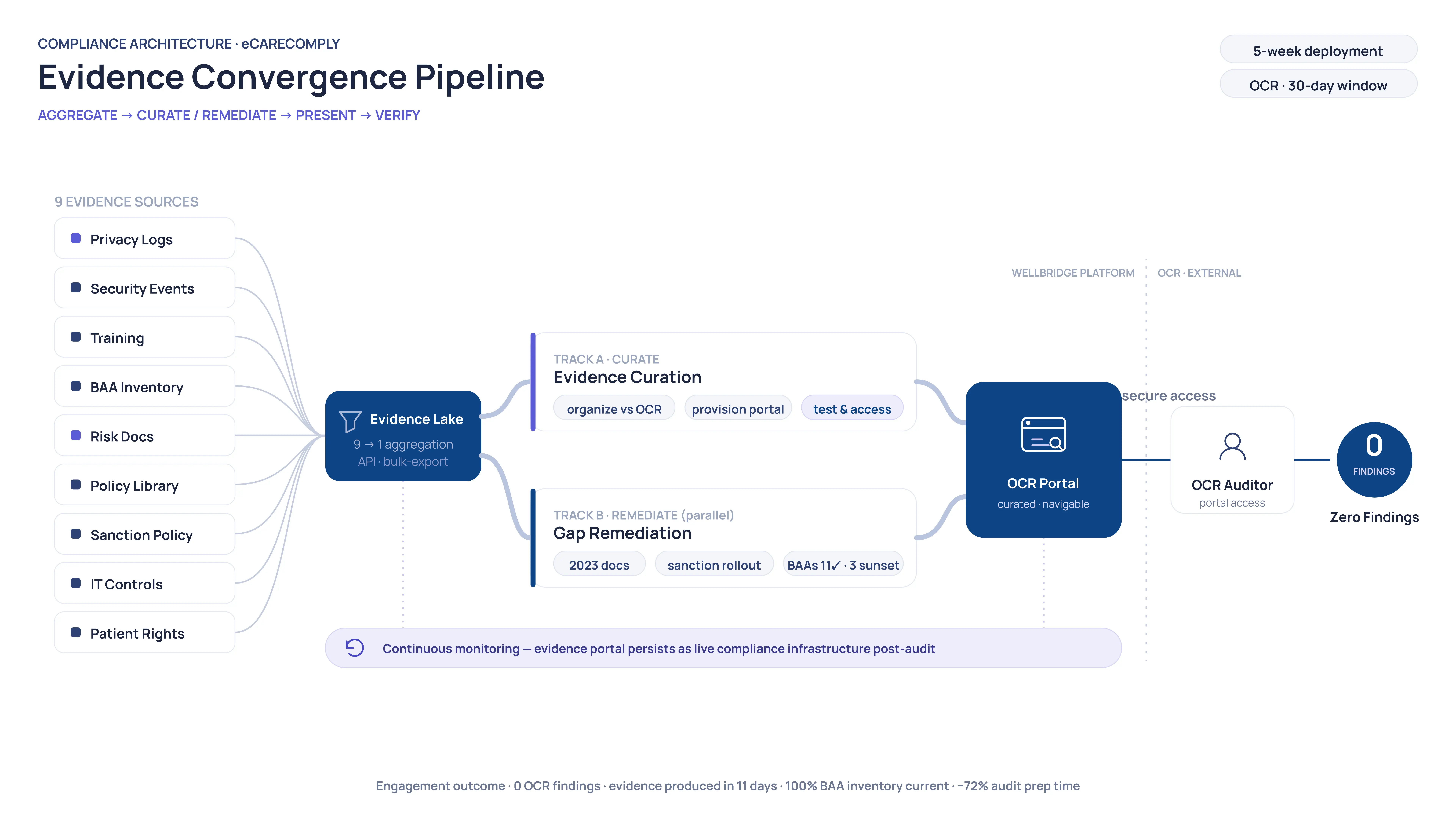
The operational challenge was specific. Wellbridge's compliance evidence lived in 9 separate systems — privacy incident logs, security event records, training compliance tracking, BAA inventory, risk-assessment documentation, policy library, workforce sanction policy, IT-control evidence, and patient-rights-request tracking. Pulling evidence manually across all 9 systems for OCR's review request would consume the compliance team's full capacity for the 30 days. Renée had 14 compliance staff; the manual production was operationally feasible but would essentially shut down the compliance team's other work for the duration.
The supporting reality made the work harder. Risk-analysis documentation had gaps from a 2023 organizational restructure when Wellbridge had merged with a smaller plan. The workforce-sanction policy had been updated but rollout to all entities was inconsistent. The BAA inventory had 14 expired BAAs that hadn't been flagged because nobody was monitoring the renewal dates. Renée's view was that the audit had arrived at a moment of operational vulnerability that wasn't of the team's making but was the team's responsibility to address.
- OCR random-sweep audit notification arrived with a 30-day evidence-production window across HIPAA Privacy, Security, and Breach Notification compliance.
- Compliance evidence lived in 9 separate systems; manual production would consume the 14-person compliance team's full capacity for the audit duration.
- Risk-analysis documentation had gaps from a 2023 organizational restructure.
- Workforce sanction policy had been updated but rollout to all entities was inconsistent.
- BAA inventory had 14 expired BAAs that hadn't been flagged due to no centralized renewal monitoring.
Solution
Renée's procurement was constrained by the 30-day timeline. She didn't have time for a typical platform-evaluation cycle. She made one call — to an eCareComply reference customer who had completed an OCR audit on the platform 11 months earlier. The reference compliance officer told her two things: the platform's evidence-portal capability had cut audit time by 60%+ in their engagement, and the deployment to operational state could be accomplished within 10 days if the leadership prioritized it.
The procurement closed in 4 days. eCareComply's compliance services team was on the ground at Wellbridge in week 1 of the audit-response period. The capability that mattered specifically was the evidence-portal infrastructure. The platform aggregated evidence across the 9 source systems through API integration; the OCR auditor was given direct access to a curated evidence portal rather than receiving evidence-by-evidence email exchanges. The auditor's review time was structurally reduced because the evidence was organized for navigation rather than requiring assembly.
The other capability that mattered was the gap-remediation acceleration. The risk-analysis gaps from the 2023 restructure, the workforce-sanction policy rollout, and the expired BAA inventory could be addressed during the audit-response window if the operational infrastructure could surface and prioritize them quickly. eCareComply's compliance services team treated the gap remediation as parallel-track work alongside the evidence production.
Value Delivered
The OCR audit closed with zero findings — a top-decile result across OCR audit outcomes for payvider organizations. The evidence production was completed within 11 days of the 30-day window. The compliance team continued operating its other responsibilities through the audit period. The acute audit-response situation produced structural capability that has persisted.
- OCR audit closed with zero findings — top-decile audit outcome.
- Evidence production completed in 11 days (within the 30-day window).
- Unified evidence portal across all 9 source systems deployed during the audit-response period.
- 2023-restructure documentation gaps closed during the audit-response period.
- 100% BAA inventory current and tracked; 14 expired BAAs were refreshed within the audit-response window.
Solution Provided
The deployment ran 5 weeks total, paralleling the 30-day audit response. eCareComply's compliance services team operated as an extension of Wellbridge's compliance team during the audit-response period.
Days 1–5: Evidence Source Integration
The first five days were technical. eCareComply's data engineers integrated the platform with the 9 evidence source systems through direct API connections where available and bulk-export mechanisms where API integration wasn't feasible. By day 5, evidence was flowing continuously into the platform.
Days 5–11: Evidence Curation and OCR Portal Provisioning
The evidence-curation phase ran six days. eCareComply's compliance services team and Renée's senior compliance staff worked together to organize the evidence against the specific control areas OCR had requested. The auditor portal was provisioned by day 9 and tested by day 11. OCR's auditor received portal access on day 12.
Days 8–16: Parallel Gap Remediation
The gap remediation work ran parallel to the evidence production. The 2023-restructure documentation was reconstructed and documented. The workforce-sanction policy rollout was completed across the entities that had been missed. The 14 expired BAAs were prioritized; 11 were refreshed through new agreements; 3 were sunset because the underlying business-associate relationships had ended.
Days 16–35: Audit Response Window
The audit response window ran through day 30 of the audit notification. The auditor's information requests were handled through the portal infrastructure rather than through ad-hoc exchanges. Wellbridge's compliance team was responsive to the auditor's questions but was not consumed by the audit's evidence demands.
Post-Audit: Operational Continuity
The platform infrastructure that had been deployed for the audit response remained operational after the audit closed. The unified evidence portal has continued as Wellbridge's compliance reporting infrastructure. The continuous-monitoring capability has surfaced subsequent compliance issues during their addressable windows rather than at audit time.
Business Value
Renée presented the 12-month engagement results to Wellbridge's risk committee in spring 2026. The framing was that the OCR audit had been managed without the operational disruption that the prior compliance approach would have required.
What the engagement preserved at the organization level
The zero-finding audit outcome preserved Wellbridge's regulatory posture in a way that would have been at risk under the prior compliance approach. The reputational asset of a clean OCR audit is real — Wellbridge's payvider customer-facing materials now reference the clean audit outcome as evidence of compliance maturity.
The financial picture
The avoided audit-finding costs (including potential remediation requirements, corrective-action plans, and reputational impact) are difficult to quantify precisely but are meaningful. The operational continuity during the audit (the compliance team continued its other responsibilities rather than being consumed by the audit response) is worth approximately $340K in preserved productivity. Total annual financial impact: approximately $1.8M against a $560K engagement cost.
What changed about compliance as a discipline
Compliance at Wellbridge has moved from periodic-audit-preparedness to continuous operational discipline. The continuous-monitoring infrastructure deployed during the audit response has continued to surface compliance issues during their addressable windows. The compliance team's effective leverage has improved because the routine work has been automated and the team can focus on judgment work.
What the compliance officer says about the engagement
“The OCR audit was the catalyst. Without the audit, we would have continued in the prior model — managing compliance through periodic crisis-response rather than continuous discipline. The audit forced the structural change in a window that was operationally feasible because the platform existed. The clean audit outcome is the headline. The structural capability is the durable result.”
— Renée Tucker, Compliance Officer, Wellbridge Health Plan